

on the haunted nature of art-making
my research and experience making talismans of the pleiades

The following piece is adapted and expanded from a previous writeup for my talismans of the Pleiades.
The Pleiades (Messier 45) is an open star cluster in the constellation Taurus, approximately 444 light-years from Earth.1 The cluster contains over a thousand gravitationally bound stars, but most observers can see only six with the unaided eye, and under excellent dark-sky conditions sometimes nine to fourteen.2 The brightest members are blue-white giants whose light scatters through a surrounding veil of interstellar dust, giving the cluster its characteristic hazy glow. They span about two degrees on the sky, roughly four times the apparent diameter of the full moon, and are visible even from light-polluted cities. In antiquity, counting how many of the seven stars one could see served as a practical test of visual acuity.3
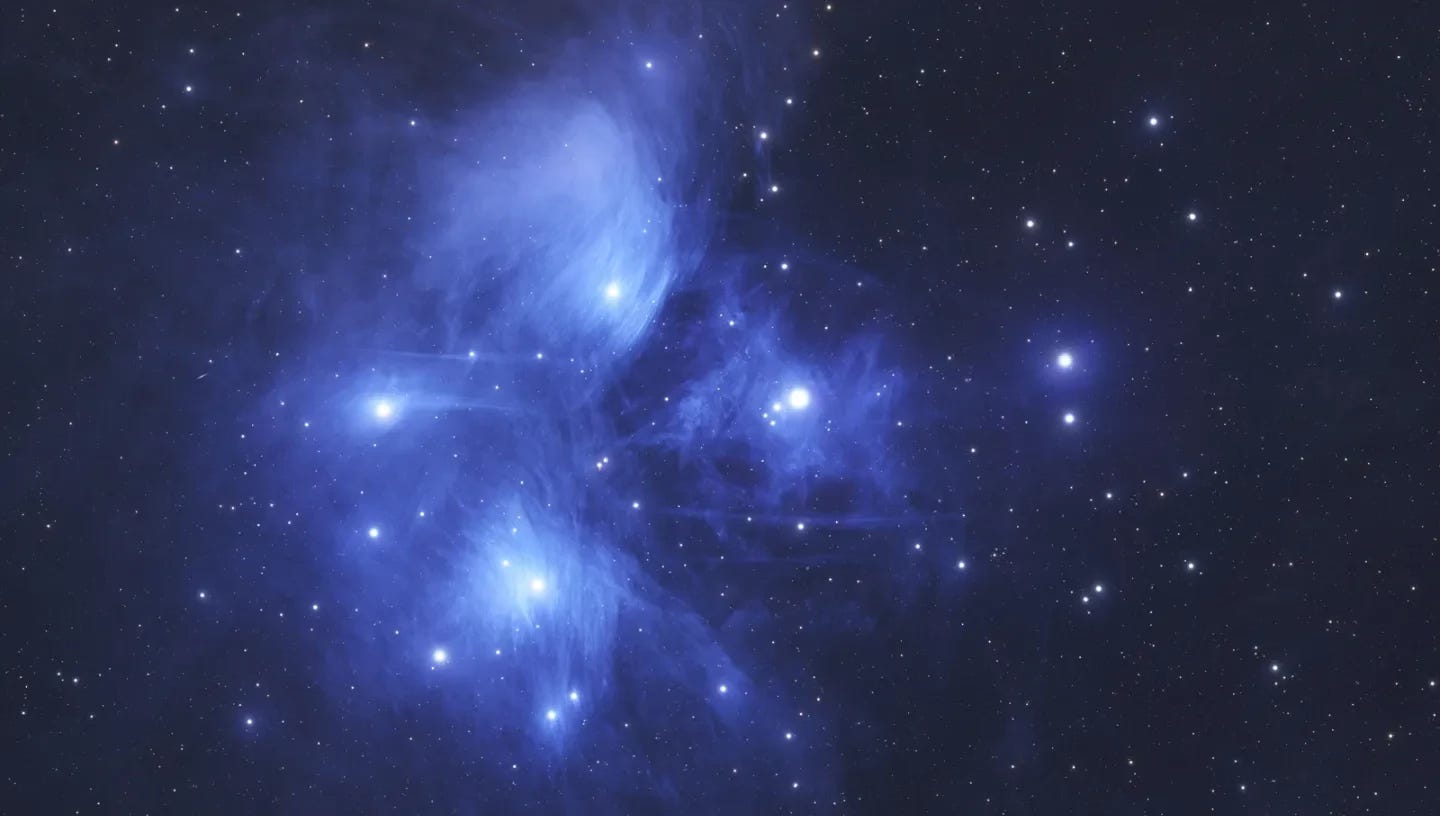
Human attention to the Pleiades may reach back as far as 17,000 years. In the Hall of the Bulls at Lascaux Cave in the Dordogne, a cluster of six painted dots floats above the shoulder of a large aurochs, and the German archaeoastronomer Michael Rappenglück has argued that these dots represent the Pleiades, making the composition a Paleolithic precursor of the constellation Taurus.4 The Babylonians recorded the cluster in their star catalogues as MUL.MUL, literally “the stars,” in the second millennium BCE.5 Hesiod, writing around 700 BCE, told farmers to begin the harvest when “the Pleiades, daughters of Atlas, are rising” and to plough when they set.6 Homer placed them first among the constellations wrought on the Shield of Achilles and made them the navigational stars by which Odysseus steered his raft across open water.7 The Nebra sky disk, a bronze-age artifact dated to roughly 1600 BCE, bears a gold cluster of seven dots identified by scholars as the Pleiades, positioned alongside a crescent moon, possibly encoding a lunisolar calendar.8

In Greek mythology the Pleiades are seven sisters, daughters of the Titan Atlas and the Okeanid-nymph Pleione.9 Six became consorts of gods: Maia bore Hermes to Zeus, Electra bore Dardanus the founder of Troy, Alcyone lay with Poseidon. Only Merope married a mortal, Sisyphus of Corinth, and hid her face in shame. This is the traditional explanation for why only six stars are clearly visible: Merope’s light is dimmed by grief. Aratus, writing around 275 BCE, states: “Seven are they in the songs of men, albeit only six are visible to the eyes.”10 The hunter Orion pursued Pleione and her daughters across Boeotia for seven years without finding them; Zeus, pitying the girls, placed them among the stars, and so Orion seems to follow them as they flee toward the west, the hunter perpetually chasing.11
Alcyone, the brightest of the sisters, gives her name to the primary star of the cluster (η Tauri), a blue-white giant roughly 1,750 times more luminous than the Sun.12 In the medieval astrological tradition she stands as the representative of the entire cluster, and the Pleiades as a whole hold a place among the fifteen Behenian fixed stars.13 Ptolemy, in the Tetrabiblos, assigned the Pleiades the nature of Moon and Mars.14 The Moon governs sight and the imaginative faculty; Mars governs heat, sharpness, and the cutting force. Under that pairing, the cluster whose talisman promises to increase the light of the eyes and summon the spirits of the dead can also cause blindness.15
One could spend a lifetime exploring the lore of these stars and their legion of spirits and still barely scratch the surface. What follows is my own personal experiences and discoveries that emerged during the extended working of creating these talismans.
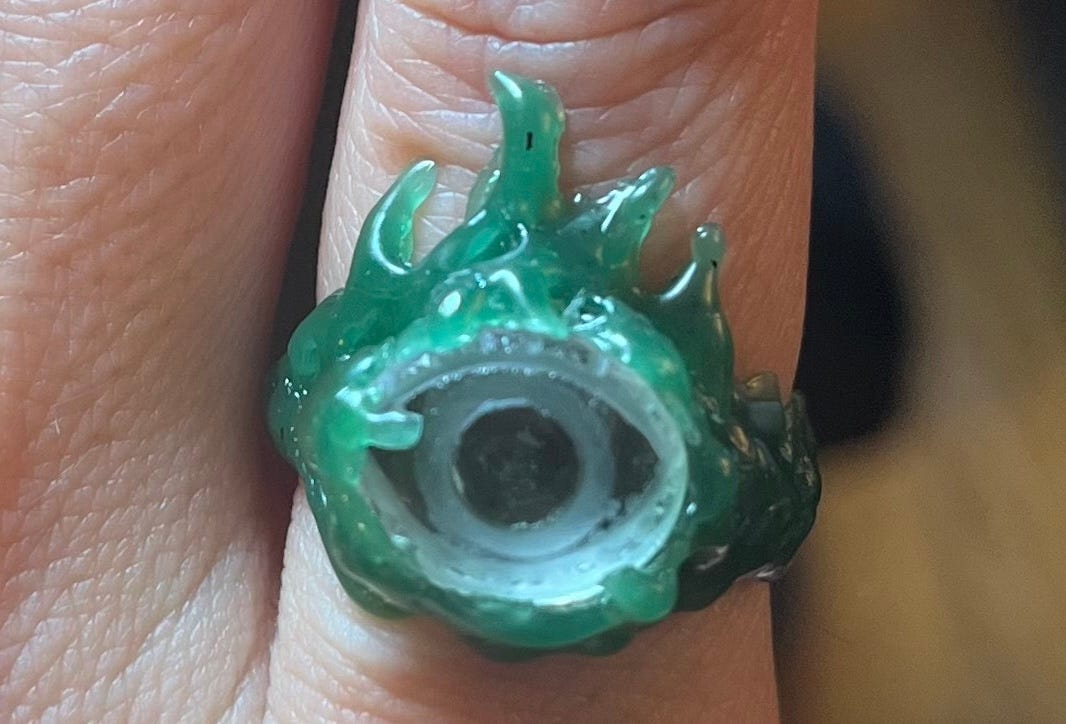
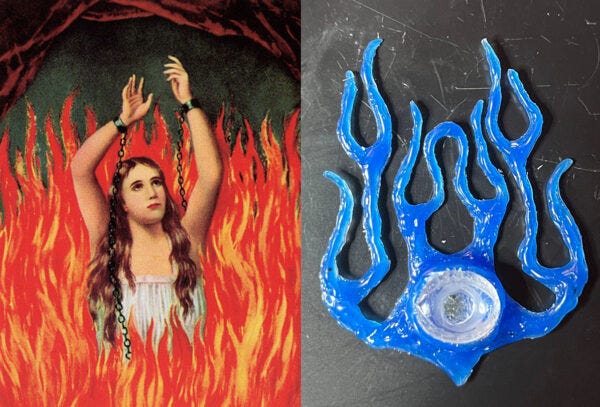
My original design for the talismans’ jewelry was the form of a ring, with flames surrounding the stone, as a reference to the associated talismanic image of a lamp. The talismans had other plans, however, and the art quickly took on a life of its own, with the spirits directly guiding their form. I scrapped the initial prototype ring and went back to the drawing board, realizing that these stones wanted to be set into a larger pendant. I knew that I wanted the jewelry to incorporate flames as the rings did, and so I began to draw. My jewelry designs typically begin as drawings, and while I was sketching out the flames, the image of a woman began to emerge. This excited me as the other talismanic image of the Pleiades besides a lamp, is a woman. As I completed the drawing, I was struck by an unexpected similarity between this figure, with her arms raised and surrounded by flames, and the Anima Sola (the Lonely Soul), a Catholic devotional image depicting a soul in purgatory, with her chained hands raised toward heaven.
I knew instinctively that there was a deeper mystery here for me to unravel, and I was reminded of a passage from Bernadette Brady’s Brady’s Book of Fixed Stars:
“The Celts also used the acronychal rising of the Pleiades to mark their month of mourning for dead friends. Prayers for the dead were said on the first day of what we now know as November. This custom is still echoed today with All Hallows Eve (October 31), All Saints Day (November 1), and All Souls Day (November 2), still celebrated as the feast days of the dead.”16
While the heliacal rising of a star marks its first visibility, the acronychal rising marks its final visibility.17 This is the moment when the star touches the cross of matter and walks among us one last time before descending into the underworld. It represents a pivotal threshold between the upper and lower worlds, and the fact that this occurs around the time of many cross-cultural festivals of the dead holds deep significance. The three-day sequence of Halloween, All Saints’, and All Souls’ is the preservation of something much older, a collective turning toward the dead that the stars marked long before any church calendar codified it.18
All Souls’ Day also holds personal significance for me, as it is the day I was born. As such the holy souls have been a source of fascination and inspiration for me since childhood through my Catholic upbringing, and have greatly informed my engagement with Catholicism magically as a fundamentally necromantic cult. Its saints are elevated dead, its relics are their physical remains, its central sacrament is celebrated in communion with the faithful departed, and its most distinctive theological invention, purgatory, keeps the living in active relationship with the souls of the dead through prayer. The Anima Sola, the lonely soul burning in purgatory with arms raised toward heaven, is a concentrated reflection of this: a soul awaiting release, enlisted as an intercessor by whoever chooses to pray for her.
I decided to explore Slavic traditions surrounding both the Pleiades and purgatory, as my father was a Polish immigrant, and the source of my Catholic ancestry.
I came upon the following passage in a paper entitled The Pleiades In The Belarusian Tradition: Folklore Texts And Linguistic Areal Studies by Tsimafei Avilin which can be found here.
While describing this star cluster, sources often draw an obvious parallel between the holes in a sieve and the stars: “Sitečko. So, it looks like sifted flour. The same in the sky: many stars in a heap” (Avilin 2015); “there are also [the Little Sieve, Blr. Maloe Sita] holes, small stars” (ibid.); “The Sieve (Blr. Sita) of stars … the stars [in the Sieve] as the holes, there are many of them” (ibid.); “Siciečka (a little Sieve) – many, many stars as intertwined” (ibid.); “[Why was it called the Sieve?] So, I don’t know, maybe because it begins to sow corn from the autumn for the winter. Close to autumn, after the Sieve has risen, it began to sow corn” (ibid.). Also notice a quite popular Belarusian riddle: “How many stars in the sky, so many holes in the ground” (key – a stubble (the lower part of the grass stem after harvesting). In the Słuck and Homiel regions some beliefs indicate this sieve is a place where souls are being sifted: “The Sieve is fiery candles in the sky in the place where righteous souls get together. Angels sift here the righteous souls from the wicked” (Sieržputoŭski 1930: 7); “The souls are sifted – the wicked to hell, and the righteous to paradise” (Avilin 2015). Meteors were interpreted in a similar way: if a star falls, it indicates that the human soul flies from Purgatory. The famous Polish-Belarusian writer Mickievič described this heavenly sieve as a reminder about the first creations of God: “To the north shines the circle of the starry Sieve, through which God, as they say, gifted grains of corn, when he cast them down from heaven for Adam our father, who had been banished for his sins from paradise” (Mickiewicz 1834: 136–137).19
What strikes me most about this is that the same stars the Celts used to mark the month of mourning for the dead were understood in the Slavic world, as the instrument through which the dead are sorted, a fiery celestial sieve and a time-marker for collective grief. And each falling star in this cosmology is a soul escaping purgatory. These and many other discoveries made during this extended working illuminated the numerous connections between the Pleiades, the dead, and mediumship echoed in their talismanic uses as described in Hermes on 15 Fixed Stars:
“Fennel seed with frankincense and quicksilver placed under a crystal with the appropriate character [engraved on it], with the Moon conjunct the Pleiades rising or at midheaven, preserves the eyesight, summons demons and the spirits of the dead, calls the winds, and reveals secrets and things that are lost.”20
Agrippa also reflects this: “Under the constellation of Pleiades, they made the image of a little Virgin, or the figure of a lamp; it is reported to increase the light of the eyes, to assemble spirits, to raise winds, and to reveal secret and hidden things.”21
During the electional window, I inscribed quartz stones, carved in the shape of an eye, with the sigil of the Pleiades. Quartz is the stone associated with talismans of these stars, and their connection with both physical and mystical vision, as well as protection from the evil eye made these a fitting choice. The stones were then enspirited and suffumigated with frankincense and fennel.
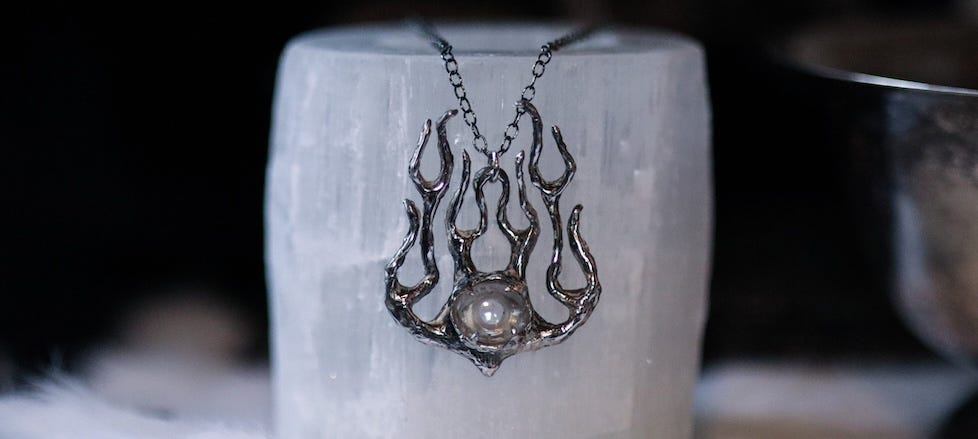
Though the ring was abandoned in this first working in favor of the pendant, I will be releasing Pleiades talisman rings in the next few months, made, as Agrippa says, to reveal secret and hidden things. If you would like to be notified when these are released you can sign up for my shop mailing list here.
other ways to connect:
my jewelry • jewelry instagram • my personal website • personal instagram
Melis, C. et al., “A VLBI Resolution of the Pleiades Distance Controversy,” Science 345 (2014): 1029–1032. https://www.science.org/doi/10.1126/science.1256101
SEDS, “M45: The Pleiades.” http://www.messier.seds.org/m/m045.html
Bohigian, G. M., “An Ancient Eye Test: Using the Stars as an Optotype,” *Survey of Ophthalmology* 53, no. 5 (2008): 536–539. https://pubmed.ncbi.nlm.nih.gov/18929764/
Rappenglück, M. A., “The Pleiades in the ‘Salle des Taureaux,’ Grotte de Lascaux,” in *Actas del IV Congreso de la SEAC* (Universidad de Salamanca, 1997), 217–225. https://www.researchgate.net/publication/260452670
Wikipedia, “Babylonian star catalogues.” https://en.wikipedia.org/wiki/Babylonian\_star\_catalogues
Hesiod, *Works and Days*, lines 383–387, trans. H. G. Evelyn-White. https://www.theoi.com/Text/HesiodWorksDays.html
Homer, *Iliad* 18.483–489; *Odyssey* 5.270–275. https://www.perseus.tufts.edu/hopper/text?doc=Perseus:text:1999.01.0134:book%3D18:card%3D462
Wikipedia, “Nebra sky disc.” https://en.wikipedia.org/wiki/Nebra\_sky\_disc
Pseudo-Apollodorus, *Bibliotheca* 3.110. https://www.theoi.com/Nymphe/NymphaiPleiades.html
Aratus, *Phaenomena*, lines 254–262, trans. A. W. Mair. https://www.theoi.com/Text/AratusPhaenomena.html
Pseudo-Hyginus, *Astronomica* 2.21. https://www.theoi.com/Gigante/GiganteOrion.html
Wikipedia, “Alcyone (star)” https://en.wikipedia.org/wiki/Alcyone_(star)
Wikipedia, “Behenian fixed star.” https://en.wikipedia.org/wiki/Behenian\_fixed\_star
Ptolemy, *Tetrabiblos* I.9, trans. J. M. Ashmand (London, 1822). https://sacred-texts.com/astro/ptb/ptb12.htm
Robson, V. E., *The Fixed Stars and Constellations in Astrology* (London: Cecil Palmer, 1923), s.v. “Alcyone.” https://astrologyking.com/alcyone-star-pleiades/
Bernadette Brady, *Brady’s Book of Fixed Stars* (York Beach, ME: Samuel Weiser, 1998).
Bruce McClure, “Halloween is an astronomy holiday,” EarthSky (updated 2017). https://earthsky.org/astronomy-essentials/halloween-derived-from-ancient-celtic-cross-quarter-day/
Ronald Hutton, *Stations of the Sun: A History of the Ritual Year in Britain* (Oxford: Oxford University Press, 1996), pp. 371–378.
Tsimafei Avilin, “The Pleiades in the Belarusian Tradition: Folklore Texts and Linguistic Areal Studies,” *Folklore: Electronic Journal of Folklore* 72 (2018): 141–158. https://www.folklore.ee/folklore/vol72/avilin.pdf
*Liber Hermetis de XV Stellis* (Book of Hermes on the Fifteen Fixed Stars), trans. John Michael Greer; https://www.renaissanceastrology.com/hermesfixedstars.html
Henry Cornelius Agrippa, *Three Books of Occult Philosophy*, Book II, Chapter 47, trans. Eric Purdue (Rochester, VT: Inner Traditions, 2021).
Such a cool example of spirit-led creativity, and how following the bread crumbs through research and intuition leads to transformation--of the initial concept, of your understanding, and of your relationship with the spirit/muse/entity, whatever it may be.
interesting, thanks